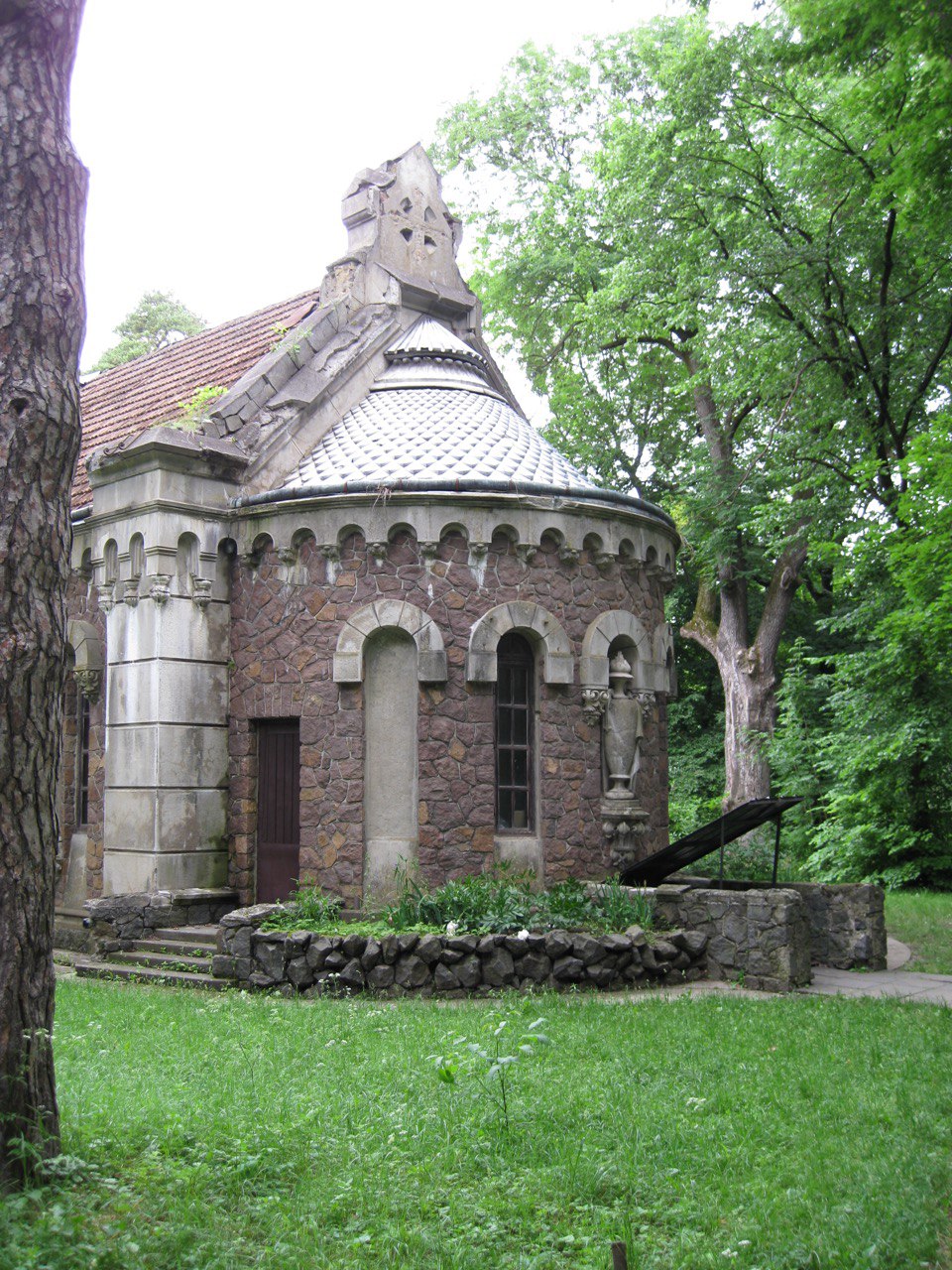
The Potocki church-mausoleum in Pechera is not an accidental building. It appeared here as a sign of presence, memory and scale — not as a church for a big city, but as a point of strength overlooking the Southern Bug.
Context
At the beginning of the 20th century Pechera was an important estate location in Podillia. It was here that the Potocki family decided to create their family mausoleum. Construction was completed in 1904. The church was conceived not only as a burial place, but also as an architectural gesture: restrained, composed, without ostentatious grandeur.
Timeline of the Church
Architecture
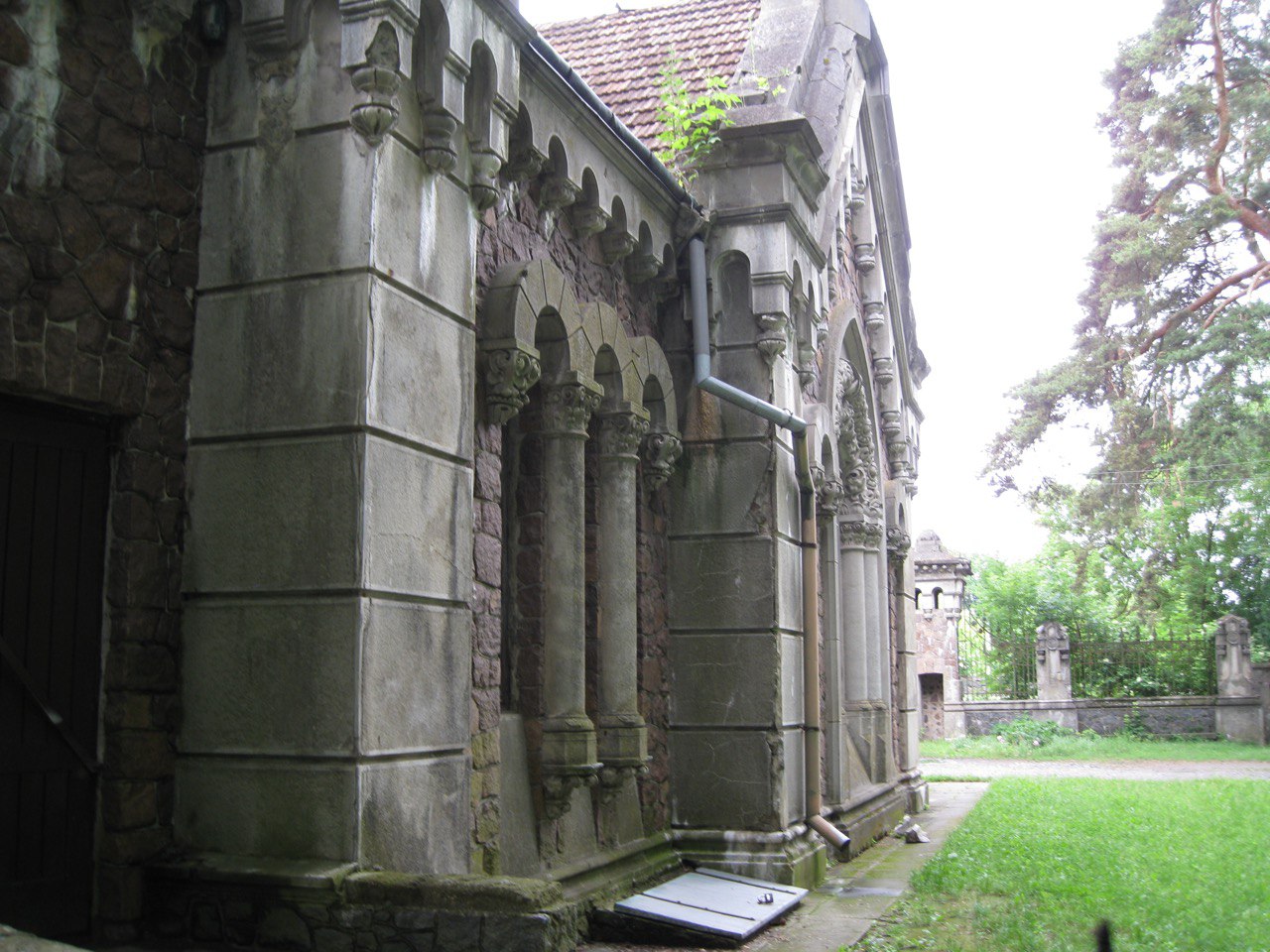
The building combines features of Neo-Romanesque and Art Nouveau. Its forms are simple and massive. The walls work as volume rather than decor. The dome and vertical elements do not dominate the landscape, but fit into it.
Technical Characteristics
Dimensions: approx. 15 × 8 × 7 meters
Floor: Mettlach tiles from the Bergenheim factory in Kharkiv
Glass blocks: model no. 9 from Blumenthal & Steck (Warsaw)
Doors: oak with decorative wrought-iron hinges
Sculptural Decoration
The sculptural decoration was executed by Elia Sala (1864–1920) — an Italian sculptor who worked alongside Vladyslav Horodetsky on the famous House with Chimeras in Kyiv. In Pechera his work is more restrained — it does not catch the eye at once, but holds the gaze.
🗿About Sculptor Elia Sala
Elia Sala was born in Italy in 1864. After moving to Kyiv, he became a key figure in the development of the Kyiv sculpture school at the turn of the 19th–20th centuries.
His most famous collaboration was with architect Vladyslav Horodetsky: Sala created the fantastic creatures for the "House with Chimeras" (1901–1903) and decorations for Horodetsky's own mansion.
In Pechera, the master executed the sculptural decoration of the mausoleum — more restrained than his Kyiv works, but with the same mastery of detail.
⚰️Secrets of the Crypt
Beneath the church lies the Potocki family burial vault — a crypt that holds the remains of members of this powerful family. Access is via an internal staircase from the chapel.
- • Konstanty Potocki — count, estate owner, patron of the church
- • Józefa née Tyzenhauz — Konstanty's mother
- • Wenceslaus — a member of the Potocki family
According to local memories, there was once another tombstone in the crypt that disappeared without a trace. One version suggests that in 1918 relatives tried to remove the Potocki remains to Poland, but this has not been confirmed.
Authorship and Details
A plaque with the inscription "Planowal Władysław Horodecki" has survived on the building. For researchers this is a special detail — probably the only known structure that bears the architect's direct signature. Another plaque carries the names of the patrons: Konstanty and Janina Potocki, with the date 1904. No explanations, like a full stop at the end of a sentence.
✦ Little-Known Facts
Falconnier Glass Bricks
The chapel windows were filled with unique three-coloured glass blocks (blue, orange and green) manufactured in Warsaw. These blocks gave the interior a special quality of light, filling the space with coloured illumination.
Carving in Wet Concrete
The impressive "stone" decor in a Romanesque-Art-Nouveau style is in fact not carved from stone. Craftsmen used a complex technique of carving into wet cement, skilfully imitating granite. For its time this was a revolutionary solution.
Underfloor Heating in 1904
The church had one of the first underfloor heating systems in Ukraine. The ventilation and heating system built into the walls was so complex that its full principle of operation still puzzles modern specialists.
Stone Lions
Two lion sculptures that once adorned the Potocki estate were later found in the river and pulled out onto the bank. Today they stand near the hospital — silent witnesses of the estate's former grandeur.
Alley and Space
A lane about 500 meters long leads to the church. It is paved with stone slabs of volcanic origin, probably brought from Odesa. The alley does not feel ceremonial; it prepares you for movement and silence.
The church itself stands on a plateau above the caves that gave the village its name. This connection between space and name is felt even without explanation.
20th Century and Today
In the Soviet period the building lost its original function. A club and cinema projector were installed here. There were discussions about creating a local history museum, but those plans were never realised. The interiors were altered, and some details were lost, yet the structure itself survived.
Today the Potocki church-mausoleum in Pechera is a place of quiet. It is not used intensively, but it is not ignored either. It exists as a memory inscribed into the landscape and into the life of the village. This is not a tourist attraction in the usual sense. It is a point at which it becomes clear that Pechera is not an accidental place on the map.